How to Get a Carné Jóven Andaluz

Ah, youth. The period of your life where everything is confusing, the future is uncertain and where you rely – perhaps more heavily than necessary – on others to stay afloat. Even as a 27-year-old living in another country, I still feel like I’m in this not-quite-an-adult limbo (like the Britney Spears song).

But don’t worry, guiri friends. The government has got your back on this one!

With the unemployment rate in Spain climbing as fast as our taxes, the Andalusian government became the first autonomy to amplify the carné jóven, a sort of discount card that can be redeemed at places all around Andalucía and Spain. Valid until the day you turn 31, shops, beauty parlors and even hotels will give you discounts by simply presenting the card and a photo ID. It’s similar to the ISIC card and can save you oodles on all types of services.

What you’ll need
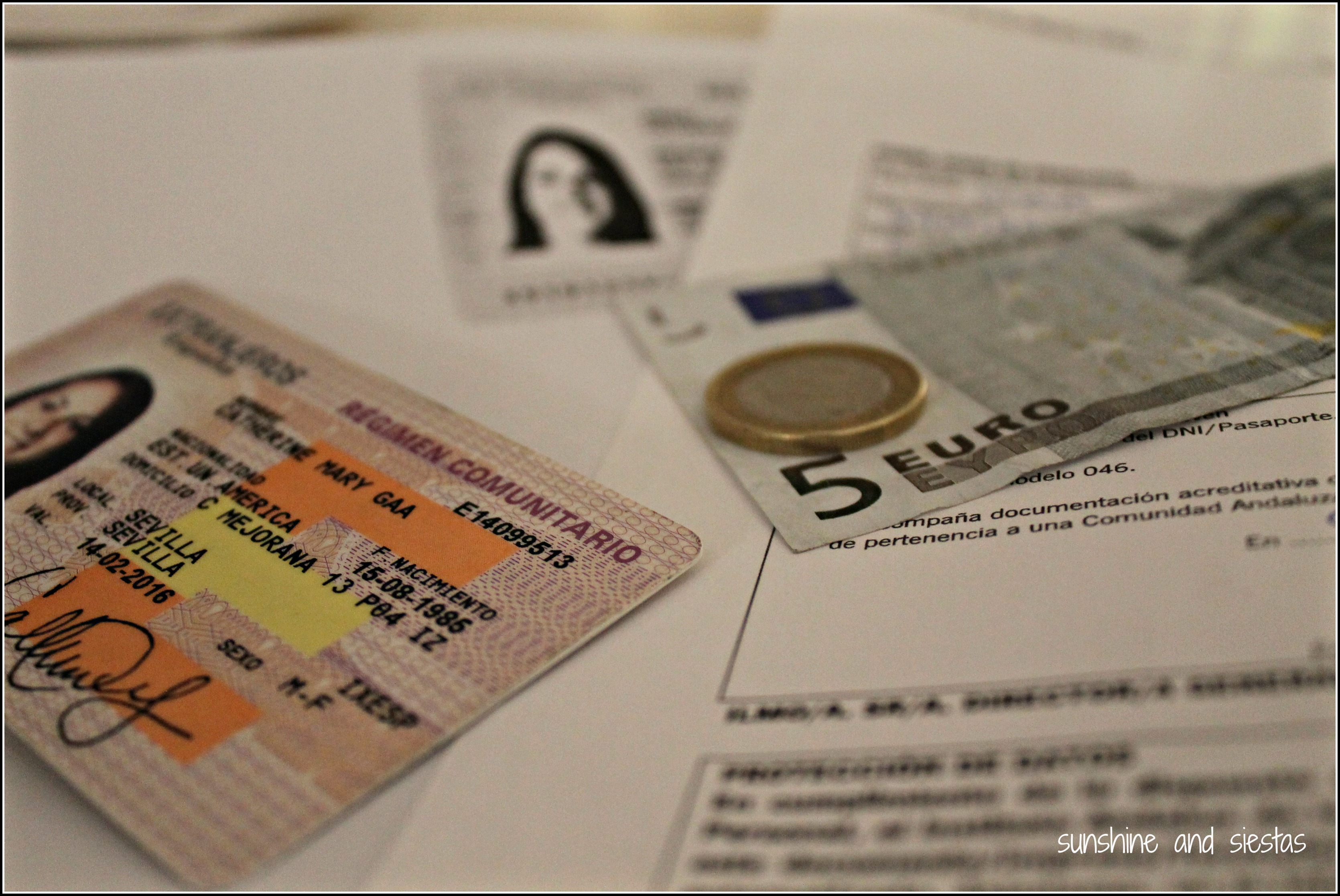
  • Your NIE and one photocopy (in its absence, your passport and proof of residency in Andalucía)
  • Form Anexo 1 (available here)
  • Proof of being Andalusian or proof of residence in the Andalusian community (usually your NIE will suffice, if not, a housing contract or bill will do)
  • 6€

Where to go

The Institutos Andaluces de Jóvenes, as well as some local banks and any offices of información juvenil in your village, are authorized to process your paperwork and give you the rights to own a card. But, as with many things in Spain, you’ll have to turn in your paperwork and THEN go to a bank with form Modelo 46, wait in another line and pay a fee, called a tasa, of 6€. Cards can be processed in the same day if turned in before 10a.m., or sent to your residence.

Similarly, there’s an online portal.

Dirección Provincial del I.A.J.
C/General Tamayo, 23
04001-Almería
Tlf: 950 00 66 00
Fax: 950 00 66 20
E-mail:informacion.al.iaj@juntadeandalucia.es
Dirección Provincial del I.A.J.
Alameda Apodaca, 20
11003-Cádiz
Tlf: 956 00 75 00
Fax: 956 00 75 20
E-mail:informacion.ca.iaj@juntadeandalucia.es
Dirección Provincial del I.A.J.
C/ Adarve, 2
14002-Córdoba
Tlf: 957 35 22 40
Fax: 957 35 22 41
E-mail:informacion.co.iaj@juntadeandalucia.es
Dirección Provincial del I.A.J.
C/ Ancha de Santo Domingo, 1
18009-Granada
Tlf: 958 02 58 50
Fax: 958 02 58 70
E-mail:informacion.gr.iaj@juntadeandalucia.es
Dirección Provincial del I.A.J.
C/Rico, 26
21001-Huelva
Tlf: 959 01 19 50
Fax: 959 01 19 51
E-mail:informacion.hu.iaj@juntadeandalucia.es
Dirección Provincial del I.A.J.
C/Arquitecto Berges, 34 – A
23007-Jaén
Tlf: 953 00 19 50
Fax: 953 00 19 70
E-mail:informacion.ja.iaj@juntadeandalucia.es
Dirección Provincial del I.A.J.
C/ Carretería, 7
29008-Málaga
Tlf: 951 04 09 19
Fax: 951 04 09 20
E-mail:informacion.ma.iaj@juntadeandalucia.es
Dirección Provincial del I.A.J.
C/O´Donnell, 22
41001-Sevilla
Tlf: 955 03 63 50
Fax: 955 03 63 60
E-mail:informacion.se.iaj@juntadeandalucia.es

source

Where it’s valid

Good news – if you’re under 27, you get a 20 – 25% discount on train tickets for the AVE and media distancia trains. Bad news: I turned 27 two months ago and no longer receive these amazing deals. Still, the card is valid all around Andalucía and in many other regions of Spain at youth hostels and hotels (10 – 15% off full price), private doctors and opticians (up to 20%), along with gyms, cafés and courses. A full list can be found clicking clicking here.

The Carné Jóven is also valid in 40 European countries if you’re 26 or under, much like an ISIC card.

If you’ve used a carné, tell me where! My main purpose for getting the card was for Renfe discounts, but I now don’t know where to make my 6€ count!

What to do With Outdated Travel Guides

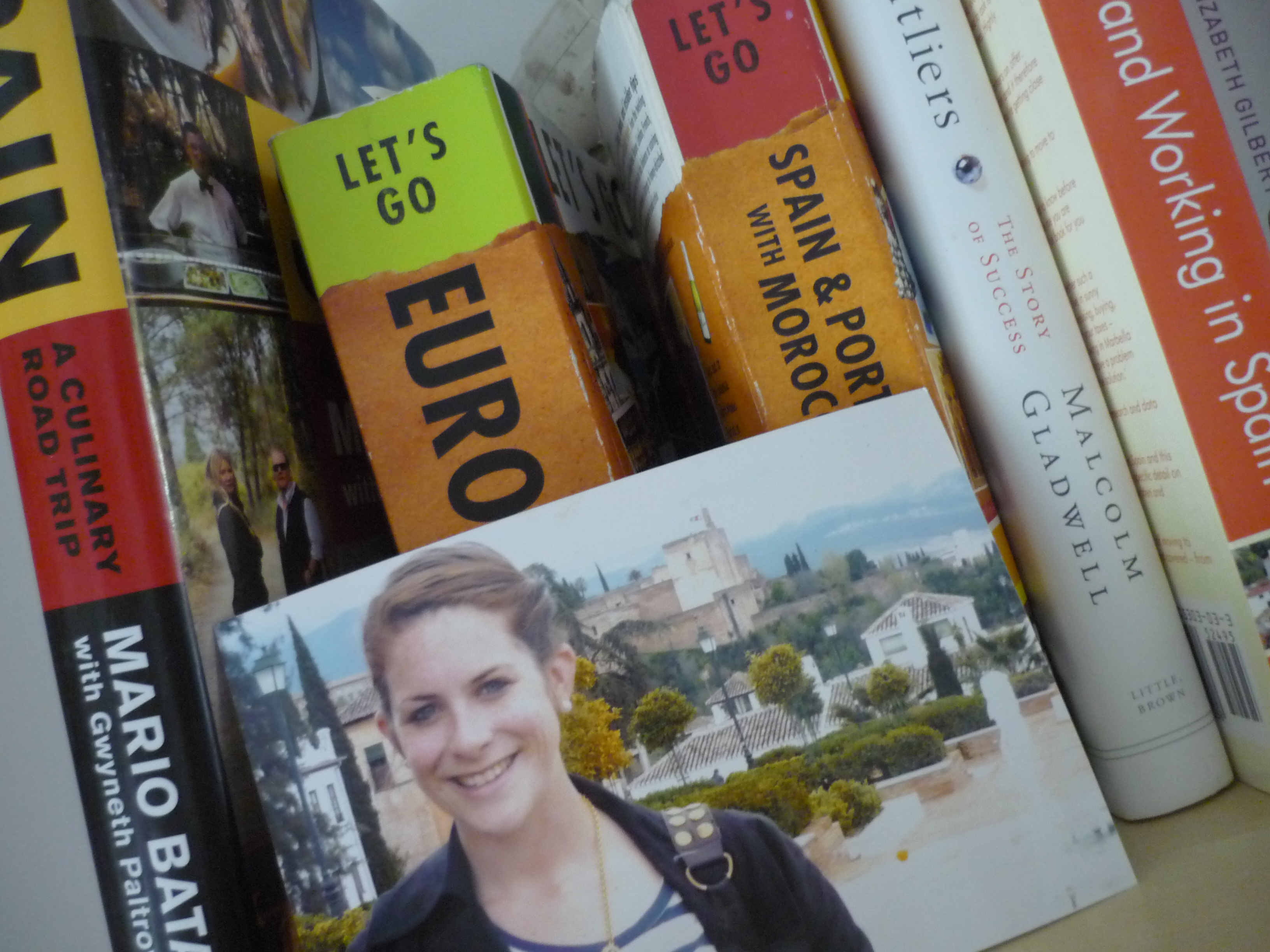
I learned the hard way just how tedious and difficult it can be to research a guidebook. After study abroad in Spain and reading every.single.page. of Let’s Go Spain 2005, I felt I knew the Iberian Peninsula in and out. I wanted to travel and eat in restaurants for free, go on tours and ride in buses to far off places, all in the name of budget travel and a small wage.

So, when I was contacted by one GG of Rough Guides, I jumped at the opportunity to help contribute to The Rough Guide to Andalucia (out May 1, 2012 – look for my mention on page 933!). I set off on the task, determined to uncover new places and tout the old ones.

The work was long, often frustrating, and needed various re-writes.

I got in contact with GG in February of 2011, and we met the following month to hammer out the details. I didn’t actually complete the work and get paid until the beginning of 2012 – due to an overhaul of the book’s design, there was more work and research to be done. Additionally, with the new government in place in Spain, the economic crisis and the normal turnover of businesses (Qué! reported in February that 14,000 new business were founded in 2011 and over 5,000 went defunct), I often had to frantically tap out an email to GG to report that a place had closed or changed hours.

Guidebooks are often obsolete the second they go to press. While they provide an excellent way to get started on planning on a trip, they often can’t be relied on blindly. So, then, what happens after your trip to SE Asia? That enormous Lonely Planet or Frommer’s you shelled out money for, what will become of it?

Trade-ins and Book Drop Offs

One of the best moments I had on my first trip to Amsterdam was browsing in the American Bookstore off of Damm Square. I was clued into the Dutch reading habit by my friend Martin, whose small apartment was full of books in many languages. My travel partner needed to do some research for her thesis proposal, so I parked it on a beanbag and browsed titles, running my fingers over bindings and through coffee table books, not wanting to start and not be able to stop a novel.

Similarly, I spent money and luggage space on books bought in Hungary at an English book exchange with incredible organic coffee. If like minds do indeed think alike, the pairing of musty old books and strong java was my idea of haven for a chilly afternoon. In expat enclaves worldwide, book exchanges and drop offs have become a way to recycle old friends and sometimes make a bit of cash.

In Seville, you could also leave your book at the Centro Norteamericano on Calle Harinas, 16-18, in the library. As one of the largest English-language collections in the city, the place takes in all of leftover books from the American Women’s Club book fair and takes up the upper patio of the restored villa. You can find Gaye, the woman in charge, during the workweek from 8:15 until 10pm (8pm on Fridays), though note that the system is based on honor, and you MUST be a member of the AWC to check books out. Similarly, the Phoenix Pub in nearby Bormujos has become a book-collecting haven for English language goods.

Leave it behind at a hostel, train station or airport with a note

Knowing my family would soon be traveling to Ireland, I picked up a copy of Frank McCourt’s Angela’s Ashes at the American Women’s Club book fair. Starting up the book in Málaga at the airport, I boarded the plane with a two-hour delay, sat on the runway for another two, was in the air for three, and sat on the ground again waiting for a gate another hour. With nothing better to do on a cramped Ryan Air flight, I damn near finished the book. I also hated myself for not having such a traumatic childhood like McCourt did. The book thoroughly depressed me.

Three days later, we arrived to still Limerick on Christmas morning. The chill and the absence of people made McCourt’s Limerick a reality to me, so I left the book on a bench near the historic center with a note on the inside flap: Reader Beware. I signed my name, printed the date and walked away.

Could you imagine picking up a book or short story in an airport and diving in? Books are to be treasured, so parting with a beloved friend can, in turn, pick up someone else’s day. Likewise, hostels are always hungry for books and provide an eclectic collection for travelers. Your old guidebooks – or books – can find a home here and become an uncovered gem for a like-minded traveler.

Decoupage

As a kid, I loved doing all kinds of crafty work and my mom took us almost weekly to Michael’s for paint, hot glue guns and the like. I started decoupaging anything I could get my hands on – often using travel magazines and the Chicago Tribune Travel section to cover notebooks, shoeboxes and pencil holders.

Now that I’ve been in Europe for over four years, I save all of my museum entrances, bus tickets and even napkins from memorable meals to decoupage photo albums. I have my camera on me at all times – even if it is just my phone’s – so my pictures are often an integral part of my trip. Signing up for photo sharing websites like Snapfish or Shutterfly will usually get you anywhere from 20-100 free prints, and I’ve scored hundreds of others for simply subscribing to the sites. My whole Ireland trip for the shipping and handling costs? Genius.

note: Amazon UK will ship for free to Spain for orders over 25£, Book Depository offers free shipping to Spain.

Plain old leave it on your nightstand, bookshelf or coffee table

In reading Rolf Potts’ Vagabonding: An Uncommon Guide to the Art of Long-term Travel, I realized that I sometimes just need a bit of inspiration to get me through a few hours’ time prowling for cheap flights. My two books that I bought back in 2009 (updated in 2008, then) serve as a good jumping off point, but I find that they’re much more practical at home than lugged in my bag. I treasure the creased pages, underlined routes and worn binding that brings me back to the souqs of Morocco or Asturias’s green coast.

My 2009 guidebooks still just sit around my house, reminding me of the thrill of going to a new, unknown place. They’ve found their home next to cookbooks and old copies of secondhand books in English and Spanish. I’ve got little trinkets all around my house that serve the same purpose – a wooden sculpture from the Merry Cemetery of Sapanta, bottles of Coke in Arabic, a Chinese New Year calendar made of plush animals. Even a good travel book can take me to destinations that seem too far to even think about visiting – as proof, I still have my first Let’s Go! Spain book, a Green Guide to Paris book from a 2006 Art History Class and a second-hand Lonely Planet to China that adorn my bookshelf back in good old America.

Calling all Andalusian-based expats: clue me in on where I can get my hand on more! I caved and got the Kindle, but love to pick up books for the beach or weekend trips.

How to Pay Taxes in Spain (aka The Day I Became an Adult)

Today was Tax Day in America.

As I sat telling my suegra of W-10s and 29-cent hamburgers, I realized I would have to turn in my borrador de la declaración de la renta before June 30th. I cursed, having never done it before. In 20120’s fiscal year, I worked not four months, therefore disqualifying myself. 2011 was different, and my measly 2% retention rate meant I’d have to pay, I was sure.

http://www.youtube.com/watch?v=YLmuFcd2Gn4

After a quick tutorial on how to solicit the draft, I signed in using my Número de Identificación del Extranjero (called a NIE, or foreign resident card). Almost immediately, I was identified with my name and address. My mouth dropped as Kike howled with laughter. I had to claim a bank account, and from there, all of my financial information was extracted and laid out before my very eyes. Not counting the two months’ vacation or private lessons or camp, I had made under 20.000€. Sad but true.

My phone buzzed with a new message from the Agencia Tributaria. They have my phone number, too!! There was a long code, which I was asked to introduce into a text box. Within seconds, a PDF containing all of my financial information from the 2011 fiscal year was compressed into an eight-page document full of words like retenciones, porcentajes and plenty more I didn’t understand. Kike checked for errors while I held my breath, waiting for the damage.

Um, it says here you can donate to a charity, Kike said. There were two options: the Catholic Church or “bienes sociales” which was probably for beefing up political salaries. I declined, writing off the for-once efficiency that seems to be lacking in every other bureaucratic issue I’d dealt with.

At the end of the seventh page, he announced how much I’d have to pay: a whopping 0€. I hadn’t reached the threshold and have no valuables, like a house or kid. So, I paid my taxes, the government knows a lot about me (but apparently not that I moved 22 months ago), and finally feel like a grown up in Espain.

But, for realz, why do I have to pay taxes if they won’t co-validate my degree or let me have a credit card?! Spain, you wack.

Happy Spaniversary to Me!

Dragging my gently worn suitcases outside, I hoisted 100 pounds of my life into to car. Four hours from that moment, after a quick lunch at Portillo’s and a long goodbye, I’d be on a plane bound for Madrid-Barajas with my grandmother, ready to reimmerse myself in Spanish life for two weeks before making a nine-month move to Seville.

Ha, what would my life be if it actually happened like that?

That, my friends, was four years ago today. That’s about 12 percent of my life, as long as I called myself a Hawkeye, twice as long as I thought I’d ever make it in the land of Sunshine and Siestas. But, here I am, quasi married, españolizada’d and just plain happy with where I’m at.

When Helen left Spain a few weeks later, after we’d spent hours on trains, long meals getting to know each other, and discovering just how many facets Iberia seems to have, she left not just Spain, but me, too. I was all alone.

I took her to the airport in Granada and cried. Where would I go from here? Well, I went to Carrefour, Spain’s closest thing to Target, and bought a comforter. This had to mean I was a real Spaniard now, right?

As I read the reactions of first timers in Spain, I like to think I hit the ground running on this whole “España” thing. When Kike and I went to a wedding and I belted out the words to an 80s song touting just how great Spain is, I received cheers, and Kike pats on the back. I love Spain, and Spain loves me right back.

McDonalds is made of skinny cows? Deep.

So, in honor of my four years in the wonderful word of Cervantes, machos, lack of tacos and people in desperate need of my native tongue (aka I have a way to earn money always), here’s four things I love about it (hint: it’s not fútbol or flamenco):

Feria

Esa semana tan emblamética…There are no words sufficient enough to describe the sight of thousands dressed in flamenco dresses, the smell of fried food and sherry (ok, and a whiff of horse poop) and the sound of lively flamenco music pouring out of striped tents. I’ve lived some of my favorite moments in the Real, a stark stretch of nothing 51 weeks of the year, and many of them have left me feeling more Spanish than American (ruffles and a big old comb stuck in your head will do that to a girl).

Food

My mother always said that food was a way to a man’s heart, employing me in the business of baked goods goddess when I was barely old enough to reach the counter. While it isn’t easy to cook in Spain with the conversion to the metric system, grabbing a tapa is as easy as walking ten meters in any direction. And, dude, do I love it all – dátiles con beicon, fabada, lentejas, gazpacho, solomillo. Since Spain has influences from around the Mediterranean and I’m the sixth member of a Spanish family, I am no longer concerned that I will whittle away to ná.

What’s more, meals in Spain are sacred. Midday grub is hearty and often lasts hours, stretching to café and then cognac. Going out for tapas is the way to be seen, be fed, and be happy – the ultimate social experiment. And Fernan Adrià has put tapas and haûte cuisine on the map in Spain, bringing fame to San Sebastian’s pintxos, Granada’s free tapas and a squealing little cochinillo in the central regions.

If you’re really daring, ask me what I eat. While I’ve never been picky, I’m certainly more adventurous (though I will never forgive my boyfriend for once feeding my pig kidney soaked in wine. Ew).

Paisajes

Maybe it’s simply because Switzerland was cloudy while I was there, but I love the varied landscapes Spain bets with. As one of the most mountainous regions in all of Europe, I have no shortage of valleys, rivers, peaks and everything in between. What’s more, Andalucía, the region I call home, meets the sea – both Mediterranean and Atlantic. The North has lush, rolling hills in Santander, stark plains in Castilla La Mancha and acre after acre of sunflower fields all over the country. Train and bus rides aren’t mundane – they’re inspiring.

La manera de ser

Call me crazy, but I love Spanish people, especially Andalusians and Galicians. The way a people can be so aware of their past, so adherent to their traditions and so stuck on living la vida buena. Anyone who knew me pre-Spain knows me as wound-up, neurotic and biting off way more than even fits in my mouse. But Spain’s attitude of mañana, mañana– just plain old taking it easy – has helped me calm down and take things as they come. That foreigner’s office business? Meh, this is Spain friends. And not having a job when school started? Well, this is the way things work here.

But somehow, I think I’ve ended up just where I wanted to be. And where I was meant to, too.

How to Survive The Foreigner’s Office

Author’s Note: This post seemed fitting today, considering my first experience with the dreaded papeleo started on July 3rd, 2007, when I applied for my student visa to come to Spain. Likewise, I just picked up my five-year residence card on Friday.

On my first trip to Sevilla, six years ago nearly to the day, I was breathless at the site of the half-moon, colonnaded Plaza de España, nestled just out of the historic center and at the helm of the plush María Luisa Park. The Triana tiles gleamed in the early July sunlight as I sat writing on a bench in the mural depicting Valladolid, a city I had just moved away from. I brought my travel partner, Catherine, the very next day. While not as bowled over as I, she did know that it was the fictional Planet Naboo of Star Wars fame.

Two years in the future, I was applying for a visa at the Chicago consulate. The deal was that Spain put a shiny visa on an entire page of my passport in exchange for 90 days in the land of toros and tapas. From there, I would need to go to local police and present a mountain of paperwork claiming I had a salary and health insurance. Seemed easy to present a few pieces of paper and stand in line.

Think again – what ensued has been a very ugly battle between me and the central immigration offices of Andalucía, a little bit of trickery (ok, flat-out lying) and finally securing a five-year residency card after thirteen months of appointments, photocopies and a lawyer.

Estés dónde estés, here’s a few tips to make your trip to Extranjeros a little more smooth:

Brush up on your vocabulary
The people who work in the oficina de extranjeros are called funcionarios. Spain, like Italy, has a high number of civil servants, and those Spaniards wishing to have job security and work short hours take an exam called an oposición to be able to be one. If selected, they are entitled to have breakfast at the precise hour you arrive to the front of the line. You’ll need to turn in all your papeleo, paperwork, to these people, so follow the advice below, too.

At the office, you’ll need to queue up and get a ticket. When your letter and number is called, you turn in your documents and receive a snobby-ass look and the word that you’ll come back for your fingerprints – your huellas, in addition to paying a tax and presenting two or three recent photos. Note that in Spain, these foto carne are much smaller than their American counterparts. After that appointment, you’ll have to wait 45 days to pick up your plastic card, and chat up a security guard to let you cut. I learned that two prorrogas in.

Know what you need to bring, and bring photocopies
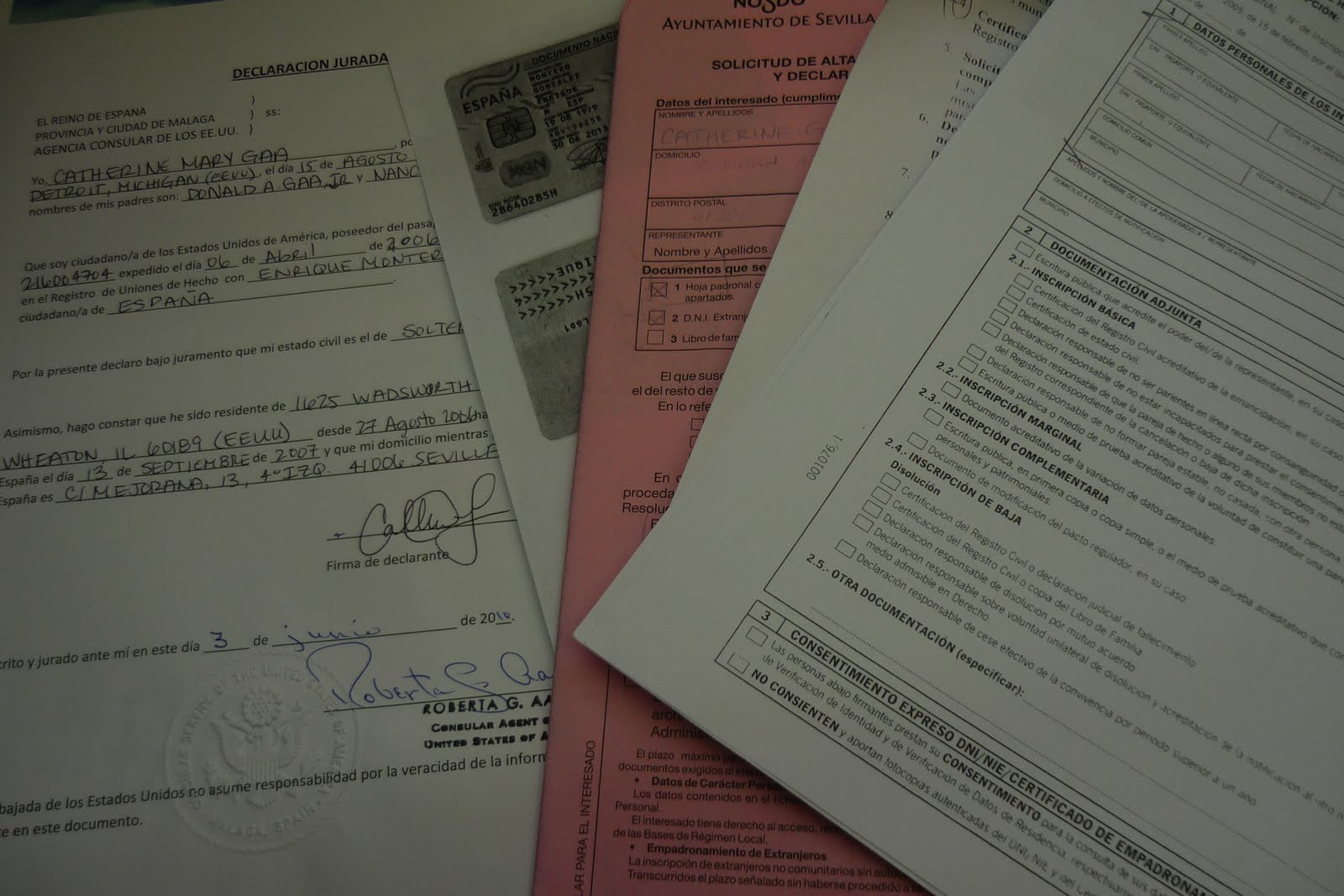
Tres fotos carné? Form EX-##? Best to do your research, as every official act performed in the office has a different set of requisites. For pareja de hecho, for example, I had to present a certificate stating I wasn’t already married, signed and stamped by an official US Notary. Not necessary for an extension on your student visa. Speak to your consulate or embassy, download the forms to turn in here, ask about tasas, or fees, and bring a few small pictures. That said, made at least two photocopies of each document and have anything notarized if it’s a copy to turn in. Believe me, this will save you headaches, as this woman can tell you. Got a stapler? Toss that in your bag, just in case.

Dress appropriately, and bring a Spaniard along if you can
Showing up and looking nice can really make a difference, especially here in Sevilla, where appearances are everything. I have been in a skirt when everyone else is in flipflops and board shorts, but am generally greeted with a smile and a willing attitude.

Likewise for bringing a Spanish friend. My dear amiga Kelly told me this as she was applying for a work visa last year. She swears that having her saint of a boyfriend along meant more efficiency and no Sevillana stink face. If you’ve got a willing friend, invite them to a coffee in exchange for a few hours of quality time with you (And by quality time I mean you pulling out your hair time).

Go at the right time
Officially, winter hours in the office are like a banker’s: 9-5. In the summer, don’t expect the office to be open past 2. I remember my first trip to the office in October of 2007, clutching a paper folder with all of my documents. I left my house barely at 6am, arriving to stand at the end of a very, very long queue. At 8am, you can get your number, but our dear friends the fucnionarios won’t roll in until after 9. For this reason, I tend to show up either right at 9am, or after everyone has had their breakfast rotation at 11.30. It’s also advisable to go after 1 p.m., as the wait times are generally shorter. Note that some tasks have only a certain number of tickets assigned each day, so if you’re merely renewing a student visa, go whenever te da la gana. If it’s something like asking for your marriage book, the earlier, the better.

Be patient
Chances are you’ll be sent to multiple offices, to numerous people. The rules for every type of trámite are complex and must be followed precisely. Use message boards, other expats from your countries and the consulate to be as prepared as possible before you go, and realize there will be lines to wait in, documents missing, frustrations to be had. But, really, it all works out. I waited thirteen months to be able to hold a little red card in my hand, and now don’t have to go back (barring a residence change) until February of 2016. A little patience goes a long way in Spain, especially in the foreigner’s office.


All you expats: Have any extranjería horror stories? Tips for making the process any degree less painful? Got enchufe somewhere? Tell me about it in the comments!

Why being sick in Spain sucks

“Cat, you haven’t missed a day of school yet, have you?” Almudena asked me while we all sat and had lunch on Thursday at school. “You must be a really healthy kid!”

I said yes, despite the lingering germs around the school. Being a preschool teacher means more tissues purchased, more trips to the dry cleaners and, generally, more sick days than anyone else in the building.

Then, on Saturday, after spending the day in the sun at the Tío Pepe bodegas in Jeréz, I got suddenly ill. My throat closed up while walking to have dinner before Beth left, my ears started buzzing and I could suddenly not swallow. Chalking it up to allergies, I passed on dinner and went to bed.

The following morning, I had a fever and could barely talk, so Kike took Beth for churros and I stayed in bed the entire day (which, if you know me, is the equivalent to being in hell), hoping to go to school the next morning.

This morning, after passing the night walking up from inability to breathe, hot flashes, a runny noise and dry lips, I had my alarm set to 8:30 to call school and tell them I wouldn’t be in. Kike took me right away to the health clinic down the street and I wrote out my symptoms since I couldn’t talk.

The lady handed me a slip of paper that read: Consulta 15 Dra. Mora 18´47.

Yes, I was sick and in need of antibiotics, but had to wait nearly ten hours to be seen by my doctor. While Spain boasts state-subsidized healthcare for all, many opt to pay for additional services through private companies. I thought back on the time where my job as an auxiliar paid for great private insurance, where the doctors knew me, including an English-speaking OB-GYN. With government social security healthcare, there is always backlog and long lines.

I suggested to Kike that I take the bus to the hospital and see someone in the ER right away. He nixed the idea, instead telling me it was better to go home and rest and just go back later. So, it was back to soup and kleenexes (though I did watch Mean Girls and have Kike home to remind me to take my meds).

When I finally got to the doctor and waited for 40 minutes, amidst cold sweats and old people, Dra. Mora told me what I’d expected: Strep. I’ve never had it before, so this is another thing to add to the list of first in Spain.

The upside? She told me I’d probably be contagious tomorrow, too.

Related Posts Plugin for WordPress, Blogger...