Tapa Thursdays: Pescaíto

One thing that stuck out about my host mother and her eating habits was that she’d fry a fish and just suck the meat right off the bones, leaving the head. Emily and I claimed we were allergic to fish to not have to eat them, vying instead for her awesome tortilla de patatas.

My, how times (and tastes) change!

Just a few Mondays ago, the Feria de Abril’s festivities began with the lighting of the main gate, known as the portada, at midnight. Right before, around 9pm, the owners and members of the makeshift caseta tents gather for a traditional dinner of fried fish, known as the pescaíto. Seville’s isn’t exactly the gastronomical gem of Andalucía (minus its tapas scene), though fried fish, pescado frito, is one of its most typical dishes.
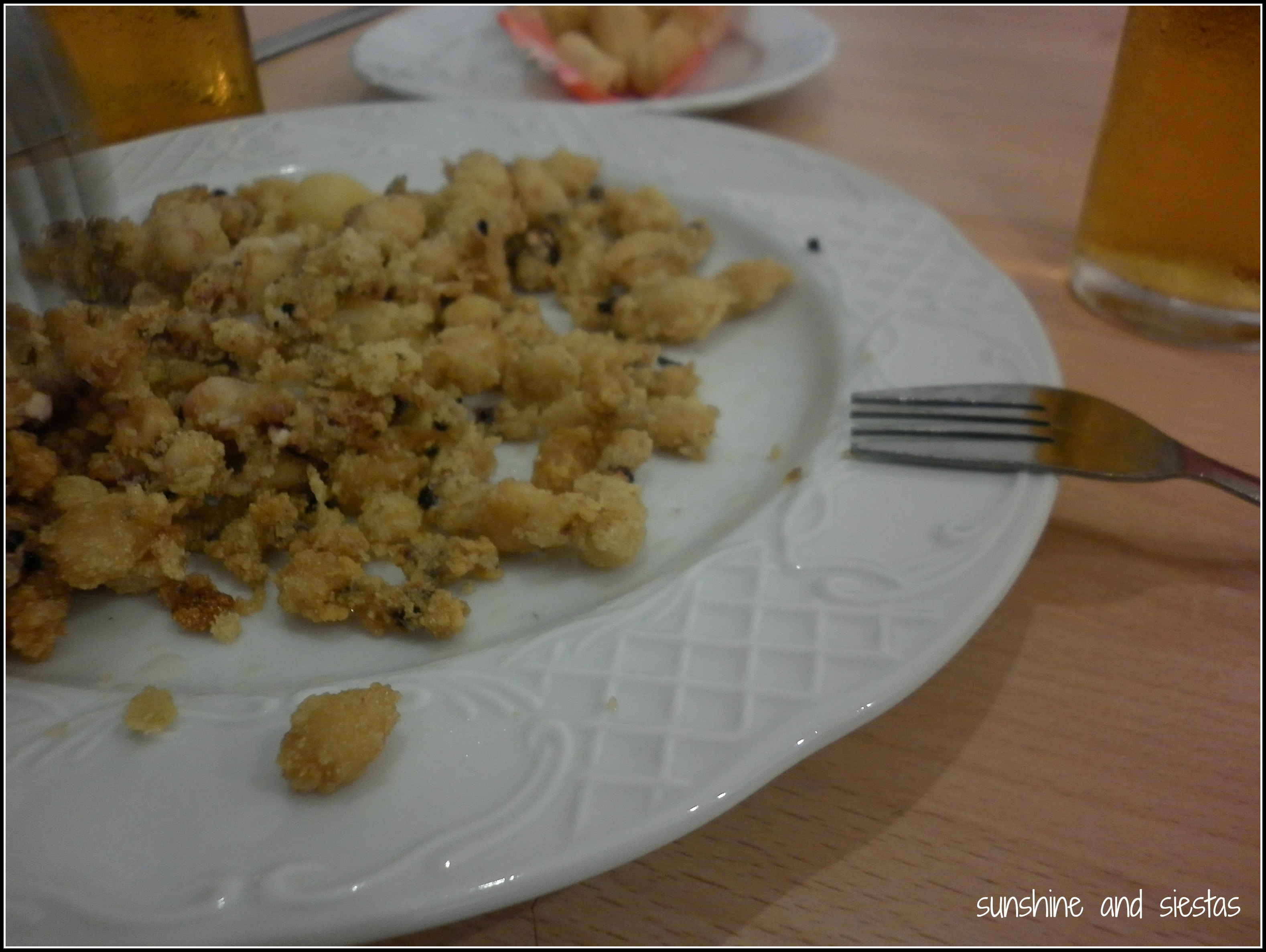
What it is: Battered and fried fish. My favorites are choco (cuttlefish), adobo (brine-soaked dogfish), puntillitas (baby squid) and sardinas (sardines).

Where it comes from: Owing to Spain’s many coasts, fried fish can be found throughout the country. It’s especially popular in Andalucía and considered one of Seville’s most typical dishes.

Goes great with: Beer, and fried onions and peppers, called calamares del campo.

Where to find it: Seville abounds with small shops called freidurias, places where fish are fried, weighed and served up hot in wax paper cones. While those I like best are in my neighborhood, I like Mara in Triana (San Vicente de Paul, 22-24), El Arenal in the barrio of the same name (C/Arfe, 8) and Frieduría Puerta de la Carne near the Jardines de Murillo in Santa Cruz. If you’re in Málaga, El Tintero is a great restaurant experience, and you can pick up sardines cooked over coals, called espetos.

 Have a favorite tapa you’d like to see touted on Sunshine and Siestas? Leave me a comment below, or on my Facebook page!

Dia del Libro: Barcelona’s Yearly Homage to the Book and my Favorite Books About Spain

Well known fact about me: I’m a huge proponent for books. I average 20 novels a year and nerd out at bookstores in Seville (and online – damn Amazon’s one-click for my Kindle!). In Spain – particularly in Cataluña – the International Day of the Book is celebrated as a day for lovers, even if only for lovers as books.

The UNESCO has delegated April 23rd as the International Day of the Book, owing to the fact that both Cervantes and Shakespeare, considered to be true purveyors of their languages, died on this day in 1616. What’s more, the feast day of St. George, the patron of Cataluña, commemorates his death and falls on April 23rd. This holiday is revered in the region, and I actually first heard of the celebration reading one of my favorite books set in Spain.

According to local legend, Sant Jordi heroically saved a princess on the outskirts of Barcelona by using a spear. From the slayed dragon’s spilt blood grew a rosebush, and Saint George pick them and gave them to the princess. Since the Middle Ages, men have been giving roses to their sweethearts on this version of Valentine’s Day, and women gift books to them. Results are a massive sale of both in the days leading up to the 23rd.

On this Catalan version of Valentine’s Day, I leave you some of my favorite books set in Spain:

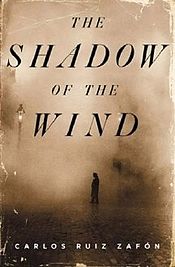
The Shadow of the Wind, Carlos Ruíz Zafón

Celebrated young adult novelist Ruíz Zafón jumped into adult fiction with this superb work of mystery and intrigue, set in Barcelona. Youngster Daniel’s father takes him to a place called the Cemetery of Forgotten Books, a forlorn library stacked floor to ceiling with obscure books. The one he chooses, the Shadow of the Wind, is subsequently devoured. When his father warns him that he must protect the book forever, a sinister man tries to destroy it, throwing Daniel into a struggle to save a book and the legacy of an author called Julián Carax. Set in post-war Spain, I had an insatiable thirst for this book, relishing in the intricate story lines and well-drawn characters. I’ve subsequently read many others by the author but not the prequel to Shadow of the Wind, The Angel’s Game.

buy it: The Shadow of the Wind Paperback | The Shadow of the Wind Kindle

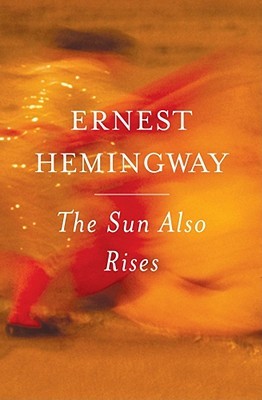
The Sun Also Rises, Ernest Hemingway

Am I the only one who felt tortured reading Old Man and the Sea? I was convinced I was anti-Hemingway, but my English lit teaching sister has set me straight. Bullfighting’s biggest proponent and the one who put Pamplona and the San Fermines festival on the map, troubled Hemingway was a Hispanophile in his own right. After having a coffee in his haunt in Pamplona, Cafe Irún, I grabbed a copy of the book with a torero emblazoned on the front. Set in 1920s Paris, a group of socialites travel to Pamplona to attend the San Fermines bullfights and running of the bulls. The book explores love, lust, masculinity and death against the backdrop of a Spanish town.

(The Paris Wife is a painful but beautifully written biography of Hermingway’s first wife, reconstructed from letters and journal entries by Paula McClain. Hadley divorced him just after the publication of The Sun Also Rises and took all of the royalties for it).

Buy it: The Sun Also Rises Paperback | The Sun Also Rises Kindle

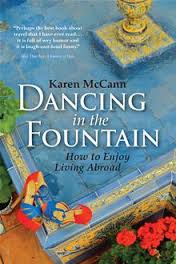
Dancing in the Fountains: How to Enjoy Living Abroad, Karen McCann

Back in the Fall, I was thrilled to give away a copy of a laugh-out-loud tale of expat life by my friend and fellow Seville inhabitant, Karen McCann. Exploring the canny and kooky, the ups and the downs, Karen’s account of swapping brutal Cleveland winters for the eternal sunshine of Spain with her husband, Rich, is spot-on. I chuckled, recognizing several of the bars Karen and Rich frequent or the characters I’ve also come to know. This delightful recounting of the dreaming to the doing is one I’ve recommended to anyone who years for the sunshine and siestas lifestyle Karen and I enjoy.

Buy it: Dancing In The Fountain: How to Enjoy Living Abroad Paperback |  Dancing in the Fountain: How to Enjoy Living Abroad Kindle

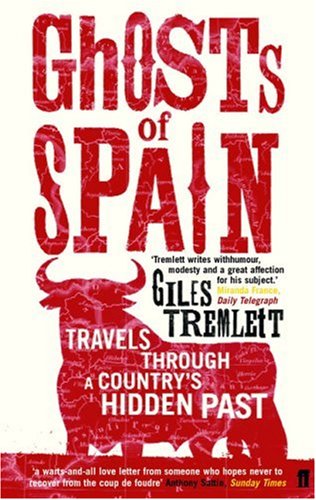
Ghosts of Spain: Travels Through Spain and Its Silent Past, Giles Tremlett

For a country know for its exuberant and open people, talking of the Civil War and the Franco years remains taboo, even fourty years after his death. Journalist Tremlett sets out to discover the dark roots of one of Europe’s more open and inviting countries. There’s talk of sex and the boom of the tourism industry, of midnight firing squads to eradicate those who cried out against El Generalísimo, of flamenco and gypsies. To truly understand a country whose history spans more than 2000 years is difficult, but Tremlett’s book about modern Spain and its secrets sheds light on modern society.

Buy it: Ghosts of Spain: Travels Through Spain and Its Silent Past Paperback

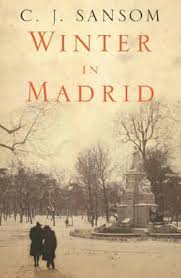
 Winter in Madrid, CJ Sansom

My second post-war novel is a spy story set in Madrid with strong, British characters who make a life in the capital under the new Franco government. Madrid itself takes on a persona as if it were a character, and it made me look differently at several barrios that I’d come to know and enjoy, and the story of lost love made it an enjoyable read.

Buy it: Winter in Madrid: A Novel Paperback | Winter in Madrid: A Novel Kindle

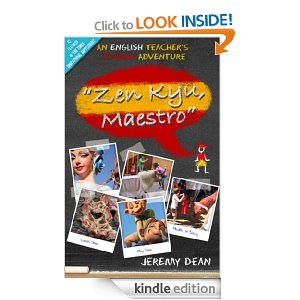
Zen Khou, Maestro, Jeremy Joseph Dean

The most recent book I read is a story that mirrors my own in many ways. Jeremy Dean left his comfortable job as a teacher in England after over twenty years to teach at a bilingual immersion school in the Comunitat Valenciana. What he finds is a school that is poorly organized, the kids not quite bilingual and his own teaching styles no match for Spanish niños. Like I said, mirrors my experience at a bilingual immersion school. Dean complements his experiences at school with the day-to-day dealings of bureaucracy and language issues, though his students (the Marias, the Jaime/Jaume and the effable Macarena) steal the show with their ganas, their progress and their gut-busting pronunciation that kept me in good spirits during my two years teaching.

One of these days, I’ll actually get around to reading Don Quijote. After all, I did by a 400 anniversary edition and threw out half of my clothes after studying abroad to make room for the 800-paged brick!

Do you celebrate Día del Libro? What are you favorite books about Spain? Like books themselves can be, these are subjective views and by no means a be-all, end-all list. I’d love to hear your suggestions – I’ll need to download onto my kindle for the Camino anyway!

On the Road Again: Getting a Driver’s License in Spain, Part II

Miss the first part of how I fought bureaucracy and came out semi-victorious? Read Part One of On the Road Again here.

Miguel dangled the car keys to his Auris in front of me. Vamanoh, he said, inclining his head in the direction of the car.

I got in, doing the mental check I’d been taught to do in the car years ago: adjust the seat, adjust the mirrors, put on my seatbelt. Miguel got in and asked me to turn on the car. Easy enough, I thought, but the car roared forward as soon as I took my foot off of the clutch. Cuidaaaaaado, Miguel cooed, busy whatsapping.

After passing the driving theory exam, I’d have to do a few classes to learn stick shift and prepare for the practical exam. Miguel told me the median amount of classes he gives per student was 30; he gave me a limit of seven. Gulp.

I drove stick once when I was 17, an exchange for convincing my mom to give my teacher, a high school friend, a horseback-riding lesson. Being a visual person, Kike had drawn me a motor and explained how the gears worked to propel a car and control his speed. Still, I wasn’t prepared to actually get behind the wheel without so much as an instruction about when to ease off the clutch and brake. Cue my 15-year-old self, nervous and convinced I’d crash into the first tree that crossed my vision.

There are two words for the verb drive in Spanish – conducir, which refers to actually steering the car and controlling the pedals, and circular, which is used for obeying signage and giving way when necessary.

Miguel steered me towards Dos Hermanas to practice highway driving while I experimented with the gear speeds and got used to the car. I was immediately relieved that I was already ahead of the learning curve and knew how to circular, so I could concentrate on what my feet and right hand were doing.

Every morning at 11:15 a.m., I became Miguel’s chauffer, taking him to drop off paperwork at the DGT or test center, picking up other students and even driving my father-in-law to the doctor’s office, just like I did when I was 15 with my own dad. I began to feel more and more comfortable behind the wheel and remembered just how much I love driving. I learned on the fly that I’d need to be in second to enter a rotunda, that right turns on red are illegal and reason to fail the practical exam, and that it was in my best interest to not speak Spanish too well.

The day before I was slated to take my practical exam, Miguel explained to my driving partner, B, what to expect. We’d be asked first to show the examiner the insurance and circulation permission, turn the lights on and off, and open the hood to point out the different parts of the mechanics. The driver then gets ten minutes to drive “de forma autónoma” or by themselves, after which the examiner would steer him through different situations, asking him to parallel park (man was I thankful I’d finally mastered that) and safely exit the car.

The driver is allowed up to ten small mistakes and automatically fails if the driving instructor, who sits in the front seat, has to slam on the brakes.

I slept horribly the night before the exam, trying to map out possible routes in my head where I knew the signage and circulation rules, careful not to pass near a school, lest any kiddies dart out between cars. What’s more, I’d freaked out the day before when I made one mistake, which led to a whole string of them. As a former gymnast, it was like falling off the beam on a mount and falling ten more times.

Rainstorms were on the forecast for that Tuesday morning, but I was convinced this would work to my advantage. Miguel picked me and another student up and took us to the testing center to wait our turn. Waiting is something that I can’t stand about Spain, and it added to the nervous feeling in my stomach when I saw the amount of cars in the lot, all waiting for the examiners to point to them and strap into the car.

When I did my driving test at age 16, my dad forced me to drive four times the minimum amount of practice hours. I arrived to the DMV to a stern-faced examiner who announced she was getting a divorce and then failed me. The last thing I wanted was to have history repeat itself.

B went first. I could tell she was nervous as she pulled out the insurance papers and tried to turn on the lights, but got the wipers instead. The examiner, named Jesús (talk about final judgment), scribbled on a piece of paper and I prayed to Saint Christopher, patron saint of motorists, that Blanca would calm down and pass the exam.

Within five minutes of leaving the testing site and driving towards Dos Hermanas, she had been failed. It was then my turn, and I was actually glad I was in an area I didn’t know – I didn’t feel over-confident. All of the flubs I’d committed the day before didn’t even creep into my conscience as I navigated around curves roundabouts and yield signs. Jesus told me he wasn’t surprised that I drove well because of my experience, and I relaxed and started to enjoy the sound of the rain outside of the car and the swish of the wipers. When we pulled into the testing facility again, Jesus didn’t ask me to show him anything under the hood, instead having me sign a waiver and promising to have my name changed on the paperwork as soon as possible (it took several days, clearly).

I got out of the car and whispered to Miguel, “¿Me ha aprobado?” He eagerly nodded his head and I began the barrage of calls to announce the good news.

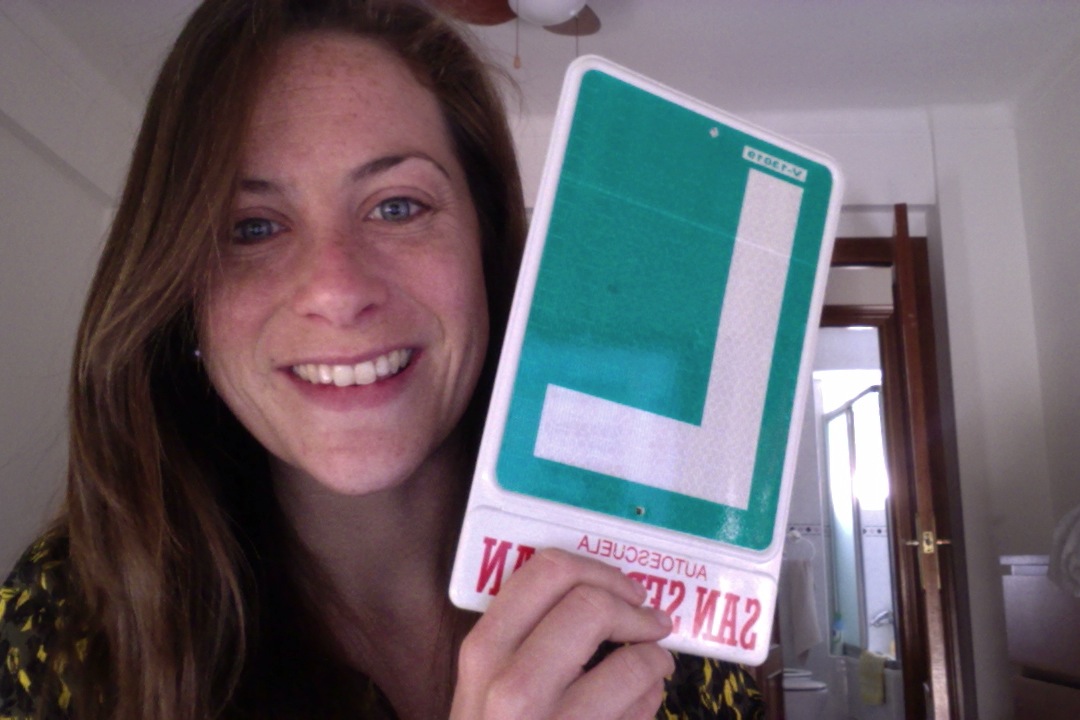
For all of the horror stories I’d heard about driving exams in Spain, I was surprised at my good fortune in passing both tests quickly. I’ve even bought my brother-in-law’s old car, a Peugeot 307, and can’t wait to be back on the open road again. And see that lovely green L? I’ll have that in my car until March 2014!

Have you ever considered taking the EU driving exam? Were you successful? Have more questions? Direct yourself to my sister page, COMO Consulting Spain for all things Spanish-red-tape!

On the Road Again: Getting a Driver’s License in Spain, Part I

It’s my argument that Spain doesn’t want me to grow up. At 27, I’ve never had a Spanish credit card (I’ve been denied three times), paid a mortgage (that’s what the Novio is for) or had to shop around for health coverage (yaaaay Socialism!). I also got away with driving the Novio’s car without an EU-license because he’s got an automatic in a country of manual cars and I figured I could play dumb guiri if I was ever caught.

But then I did get stopped and fined 100€ in a rental car. This sent my mother-in-law into a tailspin, and she told me I could be banned from driving should I get caught again. This also came on the tail of getting a speeding ticket in the Novio’s car, so she promptly announced she’d be floating the cost for a driving course as my Christmas gift.

She always knows just what to get me!

A new law, passed January 19th, 2013, now forces non-EU citizens who have resided in the Euro Zone for more than two full years to get a driving license issued by a member country. This comes from an effort to make everything in Europe more standardized, and to make me shake my finger once more at bureaucracy for making my life more complicated.

Pues, nada. I no longer had any excuse, which for years had been that I didn’t have the time, the necessity or the money to complete a course. Plus, I’d heard that the exam was difficult, particularly for a native English speaker with completely different driving rules. My mother-in-law spoke to a friend of hers who owned a chain of driving schools, and I was signed up.

My experience getting a Spanish license was similar to my first few months in Spain: I felt like I was fumbling around in the darkness, touching and feeling my way around a room, looking for the light switch and my aha! moment.  I received frantic phone calls from the driving school, asking me to bring in photocopies of my residence card, several small pictures of myself for their records, or a medical history.  Since nothing in Spain is ever easy, I had to get a check-up before I even sat in a classroom to take the theoretical course.

My theory: Don’t hit people or other cars. What more did I need to know? As it turns out, I had a lot to learn about how the Spanish system works, not to mention exactly what a clutch is used for.

Driving exams in Spain – and Europe, for that matter – consist of two parts: applicants must first pass a 30-question theory exam with a maximum of three incorrect answers, and then complete a 30-minute driving exam. I was able to do everything within just over a month, though I waited to do both the theory and practice exam due to my master’s program.

Step by Step.

The first thing you need to do when signing up for a driving course at a registered school is do a reconocimiento médico at a medical bureau. Thankfully, my in-laws run one and could get me in for free, though these certificates tend to cost around 20€ in Seville. You’ll be asked to steer two knobs to stay within the lines (think an ancient arcade game), and then have your eyes checked. That certificate is then turned into the autoescuela, who in turns sends it to the Departamento General de Tráfico, the people in charge of the roads and drivers. Have I mentioned how much I love middlemen in Spain?

Miguel, owner of the driving school, gave me a CD-Rom with practice tests to complete at home before the weekend course. Knowing that only three errors are admitted, I completed tests, frantically looking up new words like retrovisor (rear-view mirror), rebasar (to overtake) and remolque (trailer). Time and time again, a crash test dummy flashed on the screen, letting me know I’d failed with a thumbs down. I was disheartened.

On February 1st, I showed up at Autoescuela San Sebastián at 10:30 a.m on a Friday morning. My classmates didn’t show up until 5:30 p.m., so Luisa got me caught up to speed.

Did you know the DGT classifies some highways as good, and some as bad? Or that those with a license to drive a car can also drive a small motorcycle? After three hours with Luisa, my head was spinning, my hand hurt from taking notes.  She assured me that the nearly dozen years I’ve been driving in the US would be of great help with the exam, but I knew my nose would be buried in a book the rest of the weekend.

After a long break for lunch and a siesta, I returned to find that my classmates had come and that Luisa had been replaced with the owner’s daughter, Macarena. She immediately rushed up to me and gave me a hug, despite having never met me. As it turns out, she and the Novio have known each other since they were kids, when they went to sister schools and my mother-in-law would pick them up from school together. As with most things in Spain, I was getting the hook up through the age-old encuhfe that I so dislike.

My group was comprised by several others: Patricia, who had already failed the theory test half a dozen times; Marta, who had studied at another school and failed twice; Nuria, a gypsy who could hardly read and was memorizing the questions and answers; Jonni, a young boy from the barrio whose mechanically-inclined brain was of a lot of help when answering questions; Fátima, a woman from Guinea who had been studying for months and was in no rush to take the exams; and Iván, a mechanic who took more smoke breaks than practice tests.

Macarena herself was a character, as the Novio had already warned me: she compared arriving to intersections like taking a number at the butcher’s and waiting, or entertained us between practice tests with tales of jaleos she’d had in her younger years. She spoke over everyone, jumping in to help us answer questions on the practice tests until she was hoarse. Then, she randomly change her shoes and leave us alone to complete tests while she went out for a run.

Apparently this school functions on enchufe and confianza, trust – the owners would often just leave the keys at the bar next door and allow students to open as they pleased.

After close to 24 hours at the autoescuela that weekend, my head full of numbers as to how many seconds a reaction time multiplies by in the snow to how many centimeters something can stick out of the back of the trunk, I wondered how long I’d actually remember everything. I suddenly became more aware of how the Novio drove, or I’d mumble driving rules under my breath.

A week later, Miguel called me to tell me I’d be taking the theory test at the driving facility on the road to Dos Hermanas. I’d have to bring my NIE and a pen, showing up at 9:30 a.m. to complete it. I arrived by and found Jonni, who pumped me full of confidence. My heart sunk when I saw my name was spelled CTHERINE MAY on the official sign-up sheet, knowing that it would prove to be a huge coñazo when I passed both exams. I immediately told a monitor, who waved me away and told me to let the autoescuela know.

The examination room was stark with close to 30 long tables placed in rows and facing a stage in which five examiners (with novels in hand) sat. Applicants are required to turn off their phones, display their residence cards on the table and complete the 30-question test within 30 minutes. Miguel had warned me that the questions are taken from a pool of nearly 3000, which is why I was required to study the entire manual, which covers not only signage, but also mechanics, maintenance and the effects of alcohol, drugs and fatigue on a motorist.

Of these 30 questions, about twenty are giveaways whereas the other ten can be a bit trickier. I finished, confident, in about 15 minutes, knowing full well I had another chance to pass before I’d have to start paying myself for the exam. I took a deep breath, turned the test over and left out the back door.

The next day, I signed onto the DGT page promptly at 1p.m. The exams are sent immediately to headquarters in Madrid to be marked, and the scores are available at 1p.m. the day after the test. Holding my breath, I punched in my foreigner’s number, birthdate and test date and waited for the page to load.

No result found for this data.

CÓMO!? I tried again and again until it was time to leave for work, chalking it up to a delay in the paperwork once again. I checked again after work and was surprised to see there was, again, no result.

The following day, I marched over to Autoescuela San Sebastián and called Miguel. I had passed with one error, much to my relief. Miguel had even called my father-in-law to let him know to call me and give me the good news, who had then allowed me to suffer for 12 hours.

Spanish bureaucracy – 409, Cat – 1.

I’ve also published a follow-up about the practical exam prep and driving stick shift (spoiler: they just threw me in the car and expected me to know). Have more questions? Direct yourself to my sister page, COMO Consulting Spain for all things Spanish-red-tape!

Seville Snapshot: Tools of the Gypsy Trade

Moises extends his hand to me, wiping it first on the back of his pant leg. ¡Wenas noshes, hoooooooola a mis amigos, olé mis grandes señores! His greeting is always the same, and accompanied by a near-toothless grin.

I fish around in my wallet for a euro or two for him, noticing he’s wearing a turtleneck that I’m pretty sure used to be mine. The Novio offers him a cigarette and asks about his children and wife. Of all of the gypsies who live in the chabolas at the far southwestern end of town, he’s the only one I know by name, sturck by his positivity. Not all the vecinos have a soft spot for him like I do.

I don’t usually give money to beggars, but Moises is different. Sometimes, we’ll even buy him a sandwich and a beer at  Cerveceria la Tiza, which results in his insistence that I take a sprig of rosemary he’s obviously nicked from someone’s garden, or occasionally a pack of tissue. On occasion, I’ve also received flowers, and often more than I deserve for just a bit of spare change.

Stolen spices and tissue packs aside, I especially love when my coins are accepted with a tune on his cracked guitar.

¡Una rumbita pa mi americana! ¡Qué el Dios de los Gitanos te bendiga! A rumba for my American girl. May the Lord of the Gypsies bless you.

Have photos of Seville or Spain to share? I gladly accept them and run them as part of my weekly photo feature! Send me an email to sunshineandsiestas @ gmail.com, or upload to my Facebook page.

Camping on the Islas Ciès of Galicia

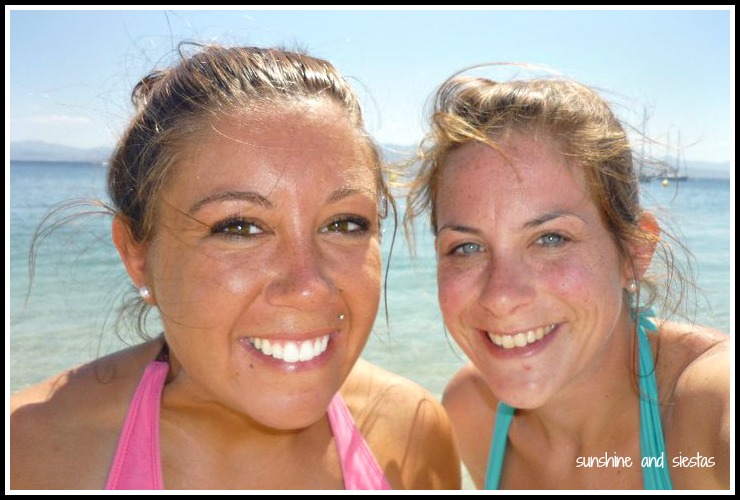
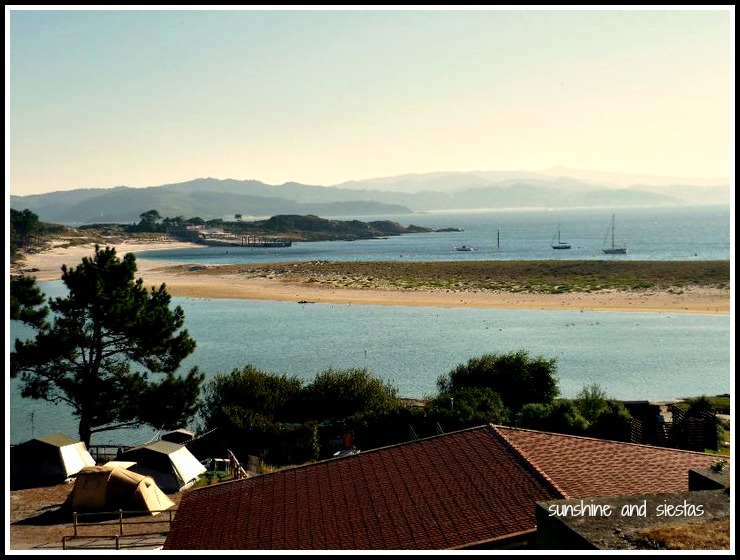
Julie and I had set out from Coruña after a two-day search for a tent. I have to admit that I’m much more of a luxury Spanish villa type of girl, but the prospect of camping on what has been called the Most Beautiful Beach in the World had me willing to sleep on the hard ground in the cold on the middle of an island in the Atlantic.

Oh, I’m also a mountain girl, for the record.

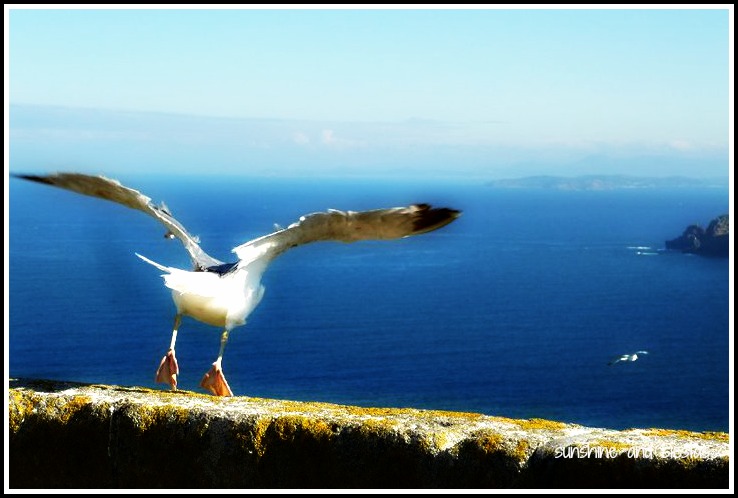
When my pulpo-guzzling, beach-loving friend mentioned the Islas Ciès, a small archipelago whose only residents are seagulls, I wasn’t immediately keen. Her father’s house on the port of nearby La Coruna was as close as I needed to get to the water because I am a chicken (tuna?) when it comes to getting my hair wet and swimming in the ocean.

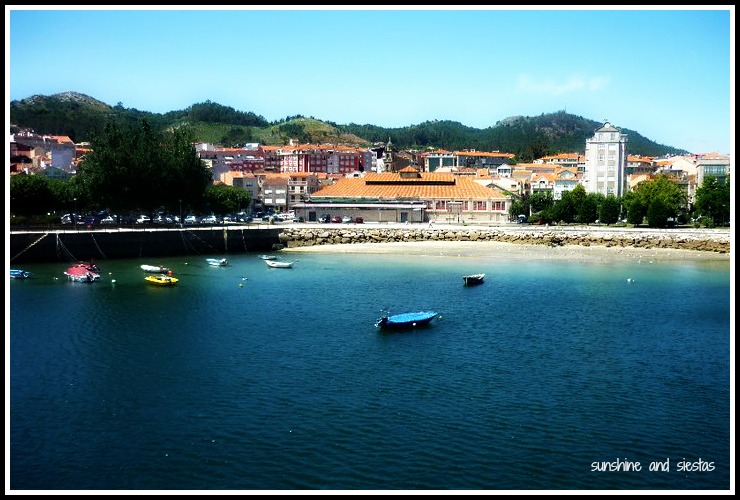
The following week, we were on a ferry from Vigo, Spain to Cangas across the river mouth and onto Playa de Rodas with little more than our swimsuits, a towel and some snacks.

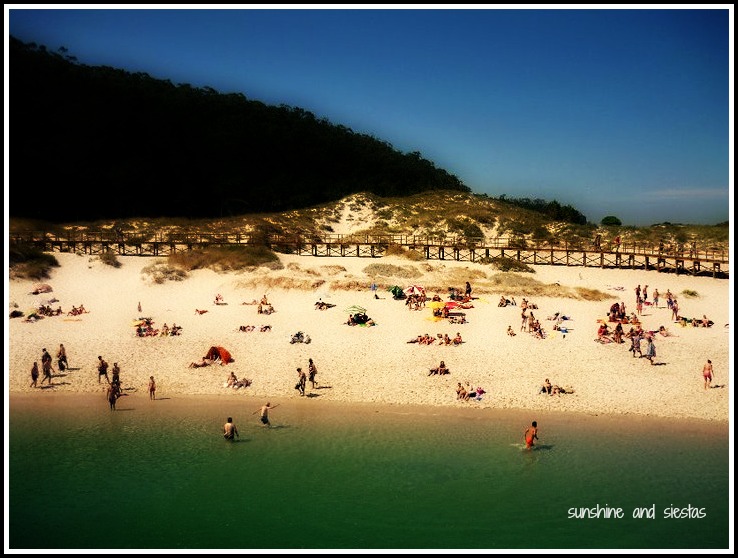
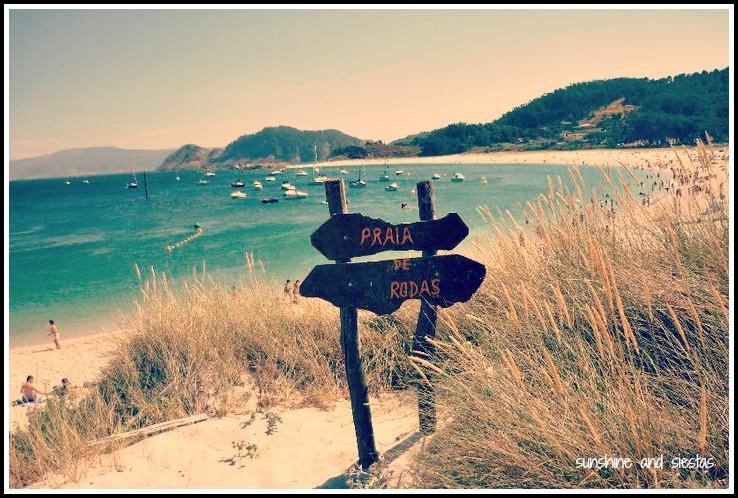
The boat docked in front of a small bar and restaurant 40 minutes later. The archipelago is comprised of three mountainous islands, the two northernmost joined together by a sandy bar and jagged rocks. Playa de Rodas, which the Guardian UK called “The Most Beautiful Beach in the World” the year earlier, was nestled between the two, idyllic and blocked from the harsh atlantic waters on the other side of the islands.

Not three minutes after we’d waded from the boat onto dry land, we’d already stripped off all of our clothes. Out came the towels and reading material, the plastic bottles of tinto de verano and all of my qualms about having gone to the beach in the first place.

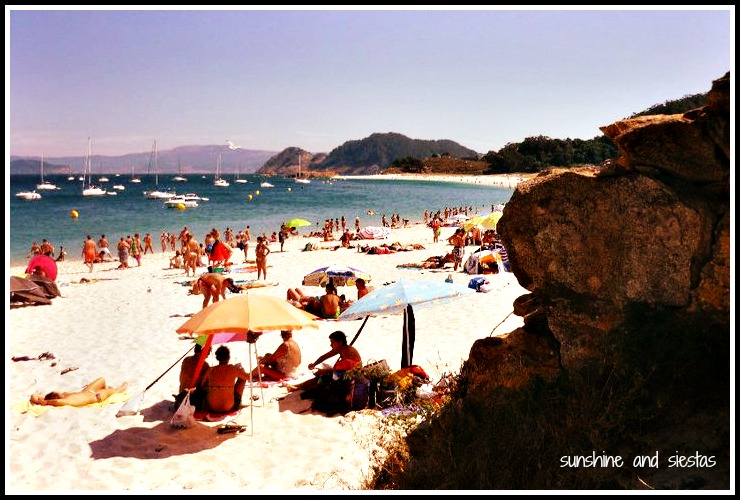
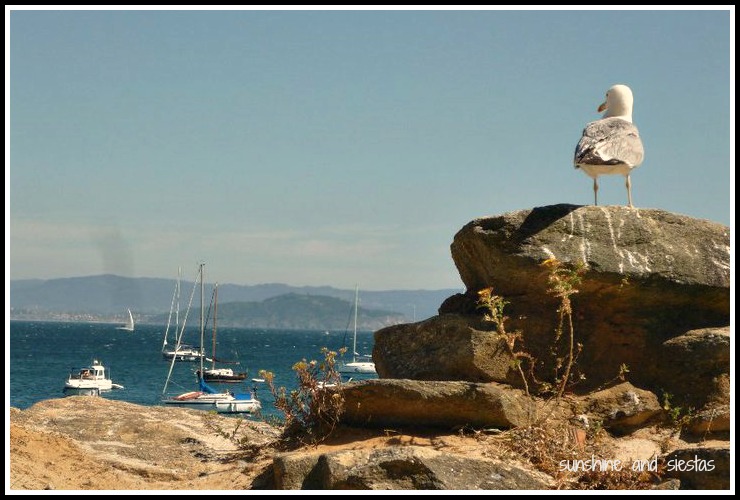
We spent the rest of the day exploring smaller, beaches tucked away in small, rocky coves and paths that lead up the crags and to clandestine lighthouses. The crescent of white sand was dotted with colorful umbrellas and beach babies, while the bay was full of small yachts bobbing gently against the tide. The squalls off the Atlantic are broken up over the craggy rocks, meaning we had a day of glittering sunshine and occasional breezes.

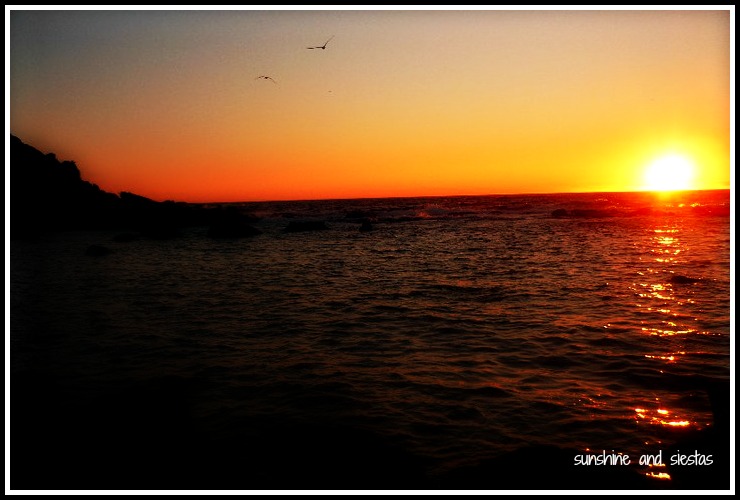
My phone rang. The campsite had been calling me all day, but our lack of a tent meant we were going to have to slip in after the sunset and find a bar spot of land in between the packed-in tents and call it a night. While we watched the sun sink down behind the ocean, I hatched a plan.

We walked over to the bar on the island, ordered two beers and a plate of fried squid legs and I asked to speak to the owner. I explained that we had been robbed when we fell asleep on the train, and that our tent has been stolen. He told us there were no physical structures on the island, save the bar/supermarket, the lighthouses and the park warden’s cabin. He promised to try and find a few blankets.

Julie and I huddled together for warmth, splitting the last few sips of wine as we sat on a park bench, the lights from Vigo shimmering on the water. A voice came from behind us.

“Are you the girls who had their tent stolen?”

Turns out, the owner of the bar mentioned to the owners of the camping that we were the delinquents who hadn’t checked into the camping that afternoon. They sent their son to hunt us down. I figured we’d be facing some sort of fine, but the boy whose name but not sculpted biceps has long been forgotten invited us to his tent. Sunburnt and with sore muscles, Biceps had a tent with two rooms and a queen-sized bed for the two of us.

The following morning, we woke up with Biceps, who was off to man the camping himself. We unzipped the screen, letting the light breeze in as our bare feet dangled over the end of the mattress. The rest of our day was filled with hiking, random rendezvous with other sevillanos and a shaky ride back to the mainland, leaving behind the gorgeous stretch of beach.

If you go: The Islas Cies can only be reached by boat from Vigo, Cangas or Baiona. Prices and hours will vary, so confirm online. There’s just one place to stay overnight, the Camping Islas Cies (7,90 adults, 8,50 per tent). Reservations should be made before reaching the island through telephone or the website, and the campsite is open from March 1. There are basic facilities for washing up, a small supermarket and a restaurant, but anything you take onto the island must also be carried off.

This is my entry to the March 2013 Carnival of Europe hosted by DJ Yabis of  Dream Euro Trip with the theme “Beaches.”

Related Posts Plugin for WordPress, Blogger...